Search
Celeste's Story with Invisible Disability
Have you heard of the National Assistance Card?
Read Celeste’s journey with invisible disability and learn how a National Assistance Card may support you.
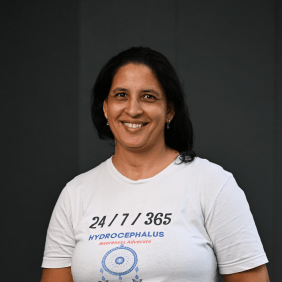
“During surgery to repeat an endoscopic third ventriculostomy (ETV) to treat hydrocephalus, I had a brain bleed. Hydrocephalus is an incurable neurological condition with the only available treatment options requiring brain surgery. Treatment options can – and do, fail, at any time. Which ultimately means a lifetime of surgical intervention.” You can read more about hydrocephalus here.
In 2021 Celeste underwent a brain surgery, where she experienced a brain bleed. This was her sixth brain surgery. When Celeste was discharged from the hospital, she was not provided clear recovery information or support to manage her at home recovery. Six weeks later, Celeste returned to work in Cyber Security awareness and training. At this point Celeste, who had over 20 years of experience working in IT, (Information Technology) said, “it soon became apparent to me that something was wrong as I struggled with my executive function; planning, processing information and decision making. This had a direct impact on how I functioned in my role… and daily in my personal capacity.”
“Tasks that had been simple and came naturally before the surgery were virtually impossible to do.”
“More importantly, though subtle, my speech was affected.”
“Cognitive decline presented slowly over the next two years, and I assumed (incorrectly) my recovery was just slow-going. At that stage I didn’t see myself as someone with a disability, but it was hard to ignore or downplay.”
“I also found it difficult to advocate for myself when consulting with my GP at the time. She wasn’t very patient or understanding of brain injury, and most times I felt like she simply spoke over, or ignored, me.”

Data from the 2025 Voice of Queenslanders Report found that ‘Invisible disabilities and communication barriers, such as low English literacy, increase risks to safety and rights.’
The report quoted one respondent who identified “In general, I feel safe when I am asked what my needs are and my needs are acknowledged and acted on.”
However, communicating your support or accessibility needs is not always as straight forward.
The National Disability Assistance Card is a support resource for people with disability to communicate their support needs.
The physical card displays summary information and a QR code, which opens to a page with more detailed information as well as a trusted contact person’s phone number.
Celeste said “I was relieved when I came across the National Assistance Card. I saw it as the perfect way to communicate when I found it difficult to do so myself.”
Celeste says:
“The best part about this is that I get to choose what I share.”
“It provides me with a sense of security, feeling more confident in knowing that it’s there, should I need it.”
“Initially I used the card at medical appointments and even at a visit to Centrelink as an opener to my conversations.”
“I would definitely recommend the card to people who struggle to communicate effectively, especially when navigating the systems and services we rely on.”
As a result of her experience and losing her job, Celeste says she found herself becoming more isolated at home and recognised the need to get back to interacting with others – at her own pace.
Celeste now regularly attends the QDN Redlands peer support group where she uses “these meetings as part of my own understanding; to foster new connections and sometimes I help others.”
To learn more about the National Disability Assistance Card click here: https://www.nationalassistancecard.com.au/
To find out more information about a QDN Peer Support Group or join a group please contact the QDN Power of Peers team on peersupport@qdn.org.au
To read the 2025 Voice of Queenslanders Report click here: https://qdn.org.au/the-voice-of-queenslanders-with-disability-report-2025/